Showing posts with label newspapers. Show all posts

Monday, 13 December 2021

No more New Paper in print, no more column

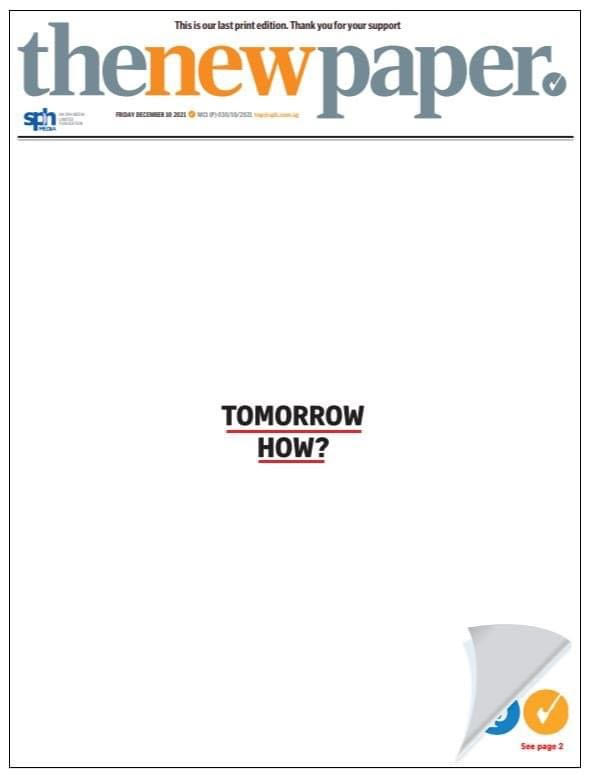
Last Friday was the last print edition of The New Paper after 33 years.


When the staff were first told about it in July, I was surprised and devastated. I was content to do what I was doing at TNP until I die – or forced to retire.

I started working there in February 2008. That’s 13 consecutive years, which is by far, my longest stretch of working at the same place. Before that, my longest was around four years at Mediacorp. Twice.

After working in television for so long, joining TNP was like going back to my roots.

I had studied journalism at the University of Wisconsin and worked at a student newspaper there as a writer and page layout artist.

I discovered that it was important to me how my articles showed up on the page. I get very upset when the headline doesn’t accurately represent what I wrote.

What many readers don’t realise is that the headline is not usually written by the same person who writes the article.

Which is ironic since many people just read the headline without reading the article and associate the byline with the headline which the writer didn’t write.

So although I set out to be a writer, I became involved in the so-called backend of the newspaper.

And it evolved such that I started doing more backend stuff than writing.

When I first joined TNP, it was as a sub-editor/columnist, but as the years went by and I re-contracted, the “columnist” part of my job title was dropped even though I still wrote the column.

My main job was as a sub-editor. At first, I did some copy-editing which I dislike, but later, mostly just did layout, which was more my jam.

More importantly, I got to lay out my own column and write my own headline.

I didn’t get a regular column right away. My first piece for TNP as a full-timer was about the Mas Selamat escape, for which I was accused of being an apologist for the Government. That was when I learnt firsthand that readers would imagine nefarious motivations and conspiracy theories behind things they see in the paper. Since I wrote the damn thing, I know the only thing behind it was me.

Subsequently, I was given a weekly Sunday column that lasted a few years, but from December 2016, it became every other Monday at my request.

While I appreciated the privilege of having such a platform in a national paper (albeit with a shrinking circulation) and tried not to take it for granted, I came to dread the week my column is due. It was like the Sword of Democles threatening to fall on my head every 14 days. It was a pain in the ass, essentially.

It was such a relief to finish a column and not have to worry about it for at least a week.

But now with the end of TNP in print, the column is done for good and it’s the greatest relief of all.

There’s talk of me continuing the column for the online version of TNP, but I would rather not.

I’m starting work at The Straits Times today as a designer and ST couldn’t care less about me as a columnist.

Writing for TNP online would just be doing extra work that’s not going to help me during my performance appraisal with my ST bosses. I don’t need the additional stress.

I didn’t even feel my TNP bosses cared that much about my column.

So… yah, that’s it.

No more column.

It’s the end of an era and start of a column-free one at ST for me.

Thanks for reading.

Tuesday, 11 May 2021

You've seen the page 1, but what was inside the paper that day? Here's The New Paper's 1997 General Election polling day coverage

You have probably seen this image of Workers' Party secretary-general Pritam Singh holding up a copy of The New Paper page one in Parliament yesterday.


Pritam Singh clash with S Iswaran over funding, editorial independence of SPH's new media entity

Posted by AsiaOne on Monday, May 10, 2021


Here's a close-up of the page:

It's from 2 January 1997, the day Singaporeans cast their vote in the 1997 General Election and more than a decade before I joined the paper.

This image of the TNP page one has been circulating online long before yesterday, but no one ever showed what was actually inside the paper. A case of judging a book by its cover perhaps?

I was curious enough that I found these pages from that day's TNP in the NLB online archives.

Sorry, I didn't look up the football pages.

To recreate more of that 90s vibe, here are the No. 1 songs that week in the US and UK.


The New Paper editor at the time was PN Balji, who ironically wrote this commentary for Yahoo:

"The government, the biggest stakeholder in the media business, needs to relax its vice-like grip on The Straits Times....

Posted by Yahoo Singapore on Monday, May 10, 2021


Thursday, 2 July 2020

How the projected 6.9 million population became 10 million: It's not a target

It started with this bombshell report about the Population White Paper released by the Government in January 2013:

Singapore's population could hit 6.9m by 2030


Which kicked off a chain of negative reactions:


To the point where the Government had to say the 6.9 million population is not a target:


Then along came Dr Liu Thai Ker to drop his 10 million bombshell:


The Sunday Times reported on April 28, 2013:
Singapore should look beyond 2030 and plan for a more distant future – perhaps even one with 10 million people, former chief planner Liu Thai Ker said at a public forum yesterday.

“The world doesn’t end in 2030, and population growth doesn’t end at 6.9 million,” he said, referring to the planning parameter in the Government’s White Paper on Population.

Singapore could do well to look ahead, perhaps to 2100 when it might have a population of 10 million, he suggested.

Mr Liu was one of five speakers at a forum organised by the Singapore Institute of Planners (SIP) and co-hosted by the National University of Singapore’s Department of Architecture, on the topic of planning for 2030.

Mr Liu, who used to head the Housing Board, argued that population growth is necessary for economic growth.

And since Singapore’s land area is essentially fixed, higher density is thus inevitable.

But he was optimistic that “high density and a better living environment are mutually compatible”.

Liveability can be preserved with adequate amenities, buffers of greenery, and alternating denser and less dense areas.
Since Dr Liu used to head HDB, some took what he said as the view of the Government even though it wasn't.

He reiterated his 10 million population stand on The Business Times front page the next year:


And again in The New Paper in 2017.


With headlines like these, no wonder many mistakenly believe the Government is pushing for a 10 million population even though Dr Liu doesn’t speak for the Government.

Then The Straits Times reported this about DPM Heng Swee Keat at a ministerial dialogue at NTU last year:
On the projected population of 6.9 million by 2030, set out in the Government's 2013 Population White Paper, Mr Heng said the number goes beyond how densely populated Singapore would be. The social space is as important.

Singapore's population density is not excessive, he said, noting that other cities are a lot more crowded in terms of liveable space.

He cited former chief planner Liu Thai Ker, who said in 2014 that Singapore should plan for 10 million people for it to remain sustainable in the long term.

Many, including SDP chief Chee Soon Juan, jumped on the "cited" part of the report as Mr Heng's confirmation of the Government's endorsement of Dr Liu's 10 million population fixation, although it was hardly a smoking gun.

Dr Chee campaigned on this issue with his "NO TO 10 MILLION Population" tagline:


And brought it up in last night's debate: "Mr Heng See Keat comes up and states in an interview, toyed with the idea of bringing our population up to 10 million. Singaporeans are deadly worried about this proposal."

Foreign Minister Vivian Balakrishnan called it a "falsehood".

Dr Chee said it was "Mr Heng Swee Keat that came up with the idea of the 10 million population" and added "I'm citing the interview."


The "interview" Dr Chee was referring to was the one at the ministerial forum reported by ST last year.

After the debate, he shared the ST article on Facebook:


Which doesn't really prove that Mr Heng said what Dr Chee said Mr Heng said, although I understand how it could be misinterpreted that way.

UPDATE: Here’s a transcript of what Mr Heng actually said at the forum:
But seriously on the population issue, 6.9 million number that was put out earlier on. In fact, I met Mr Liu Thai Ker, our former chief planner, I think he had publicly said, it has been reported in the papers that we should go for even higher number and that how this little red dot can accommodate many more people. Now whether this little red dot can accommodate many more people actually is not strictly just a physical constraint. We cannot be thinking of 50 million people on this little red dot because it will just be so dense and unpleasant. But the population number is not just about physical space, it is also about the social space, it is about the sense of togetherness.


So he didn’t mention the 10 million figure at all.

Mr Heng himself finally responded this morning with his own Facebook post:
As the Straits Times clarified this morning, I did not say that Singapore should plan to increase its population to 10 million people, nor did I mention the figure.

I was asked at the NTU Student Union Ministerial Forum in 2019 about the Population White Paper. In my response, I mentioned that former chief planner Liu Thai Ker had publicly said that we should go for an even higher number. Far from endorsing this, I had explained that our population size was not just about physical space, but also about social space and how we can preserve a sense of togetherness.

Let me be clear: The Government has never proposed or targeted for Singapore to increase its population to 10 million. And if we look at today’s situation, our population is likely to be significantly below 6.9 million by 2030.


That is as definitive as it gets.

Even SDP has accepted it and claimed credit for it:


But does it mean this whole "Government wants Singapore to have 10 million population" thing is finally dead?

I doubt it.


PAP should be really annoyed with Dr Liu right now.


UPDATE: Did Nikkei Asian Review really report that URA plans to build underground infrastructure for 10 million population?


UPODATE UPDATE: Post-election, Dr Liu finally spoke on the controversy he created:


Monday, 6 April 2020

How it started: Evolution of The Straits Times coverage of the 'Wuhan virus' in one month

Nowadays, it seems that the news is nothing but the coronavirus. Of course, it wasn't always like this.

This was how it started:

January 1

The first Straits Times print report of the virus was on New Year's Day under World Briefs on page 15:
Sars-like outbreak suspected in Wuhan

BEIJING Chinese experts are investigating an outbreak of a respiratory illness in the central city of Wuhan that some have likened to the 2002-2003 outbreak of Sars (Severe Acute Respiratory Syndrome).

The city’s health commission said in a statement yesterday that 27 people had fallen ill with a strain of viral pneumonia, seven of whom were in serious condition. However, the health commission said the cause of the outbreak was still unclear and called on citizens not to panic. ASSOCIATED PRESS
It was a very small story.

See if you can find it on the page.

Two days later...

January 3

January 4

Four days into the new year, Wuhan was on page 1 but only as a side story with more reports on page 8.


January 5

First suspected case in Singapore, but it's just a small story on page 1.

January 6

No virus news on page 1, just a report about the "Wuhan flu" in Hong Kong at the bottom of page 4.


January 7

Back on page 1 but still a small story with another report on page 9.

January 8

Just one foreign report on page 11.

January 10

Shockingly, no news about the virus at all.


January 11

Second suspected case in Singapore and it's reported on page 4.


January 12

Just one foreign story on page 8: China reports first death.

January 13

No news about the virus at all. Zero. It would not happen again.

January 14

Small virus story on page 1 as first case outside China is reported.

January 15

Only foreign reports for the next few days.

January 16

January 17

January 18

January 19

Finally, the virus becomes the lead story on page 1 and it hasn't left the front page since.

January 20

January 21

January 22

January 23

January 24

January 25

January 27

January 28

January 29

January 30

January 31

And that's how the virus went from a small world story on page 15 to the only story we care about in one month.

Sunday, 15 July 2018

Press Gang review: I heard a rumour


So I went to see to the Saturday matinee performance of Press Gang at Lasalle College of the Arts yesterday. Lim Kay Siu (Frankie Foo) was sitting in a row in front of me.

It wasn't cheap — $144.50 to book two tickets for my wife and me from Sistic and that's after a 10 per cent discount with my POSB debit card.

But I wanted to support the playwright, Tan Tarn How, whom I consider a friend, though we haven't seen each other for maybe 20 years. I knew him at Mediacorp in the 90s when he was the head writer of Growing Up and, of course, VR Man.

I had never seen any of his plays before, but I wanted to see the Ivan Heng-directed Press Gang because it's about working in a Singapore newspaper, something I have been doing for the past 10 years.

The play is set mostly in the newsroom of Singapore Times, a sort of fictionalised version of The Straits Times where Tarn How used to work.

At the start of the play, I grinned in recognition when I heard the word "offstone" and the line about subs screwing up headlines and captions, although actor Shane Mardjuki said "offstone" with an odd emphasis like the word was alien to him.

Actually, I found that the whole cast spoke with a mishmash of distracting accents like in a Channel 5 drama. I don't know. Maybe local English plays are supposed to be like this, but the often stilted dialogue didn't help.

I was also distracted by how much actor Benjamin Chow resembled US actor John Cho (Sulu in the new Star Trek movies) without sounding anything like John Cho. But that could just be me.

The thing that really took me out of the play was the central dilemma that drove the plot: Should the paper report the rumour that the prime minister's son slapped the deputy PM?


The problem is, there's no dilemma at all. Newspapers, in Singapore or anywhere else, aren't supposed to report rumours, regardless of who the rumours are about.

And it's not because we're afraid of the big bad Government. It's because we know rumours may not be true. That’s why they’re called rumours.

And despite lapses, journalists generally still care about stuff like that. Don’t wanna be accused of fake news. Or sued for libel.

If the paper wanted to pursue the story, it would just try to get someone to confirm on record that the incident happened and report that. Otherwise, no story.


But is the slapping story even worth pursuing in the first place? This was where the play felt a little outdated despite references to Facebook and Hardware Zone.

We're living in a time where our real-life Prime Minister's sister has outright accused the PM of abuse of power on Facebook for all to see. The play’s slapping rumour seems rather quaint in comparison.

I should explain here that in the alternate universe of the play, even though Facebook and Hardware Zone exist, Lee Hsien Loong doesn't. The PM in Press Gang is an unseen fictional character who may or may not have a resentful fictional sister.

So it's weird that in this alternate universe, there's also mention of an earlier fictional slapping incident similar to the one brought up by real-life then PM Goh Chok Tong in his 2003 National Day Rally speech:
"You may also have heard this old story about Loong. In case you have not, I'll tell you now. Back in 1990, Loong had a quarrel with Richard Hu. S. Dhanabalan sided with Richard. Loong lost his temper. He reached across the table and gave Dhanabalan a tight slap. The whole Cabinet was thrown into commotion. I then forced Loong to apologise. I must be suffering from amnesia. I just cannot remember this incident. Now you know how creative Singaporeans are."
It can get a bit confusing trying to distinguish what in the play is real, based on something real or totally made-up. But that's part of the fun.

For instance, the columnist played by Amanda Tee is obviously based on Sumiko Tan in a surprisingly self-aware portrayal.

My wife believes that the Malay character played by Oniatta Effendi is based on Zuraidah Ibrahim, an ex-Straits Times editor who moved to Hong Kong with her husband, Cherian George, who also got (half) name-checked in the play.

The veteran reporter played by T. Sasitharan, who got the best lines, reminded me of former New Paper (now back at Straits Times) editor Dominic Nathan physically if not character-wise.

I have never worked at The Straits Times, so I can't comment on how accurate the office politics or politics politics depicted in the play are.

From my perspective at The New Paper, which is at best Straits Times-adjacent literally, figuratively and organisationally, parts of Press Gang rang true, but much of it sounded like Tarn How straining too hard to make a point, however valid that point may be.

But the whole "Should we print a rumour?" thing just didn't work for me.

In an early scene, there was mention of the paper previously reporting someone having an affair (safe to say, based on real life).

I might have enjoyed the play more if it were about that instead.

Press Gang ends its run tonight.


TRENDING POSTS OF THE WEEK